

How to Check Wiper Blade Size: A 2026 Guide
Table of Contents
- Why Getting the Right Wiper Blade Size Matters
- How to Check Wiper Blade Size: Three Reliable Methods
- Types of Wiper Blade Connectors Explained
- Signs Your Wiper Blades Need Replacing
- How to Fit New Wiper Blades: A Step-by-Step Guide
- Common Mistakes When Checking Wiper Blade Size
- Frequently Asked Questions
Last Updated: September 15, 2026
Why Getting the Right Wiper Blade Size Matters
Wiper blade size is the measurement, in millimetres or inches, of a single blade from tip to tip, and getting it wrong is one of the most common reasons drivers end up with a streaky, noisy windscreen. This guide from Vipa Car Parts walks through how to check wiper blade size using three methods that work on any car, from a 2008 hatchback to a 2025 SUV.

A blade that is too long will foul the windscreen pillar or overlap its neighbour. Too short, and it leaves an unwiped arc right in your line of sight. Neither is a safety failure you want to discover mid-downpour.
According to GOV.UK's MOT inspection manual for cars, wipers and washers are checked as part of the roadworthiness test, and a blade that smears or fails to clear the screen can be logged as a defect. That alone makes sizing worth ten minutes of your time.
Below, we'll show you exactly how to check wiper blade size three different ways, explain the connector types you'll meet, and walk through fitting a new set properly.
How to Check Wiper Blade Size: Three Reliable Methods
The most reliable way to check wiper blade size is to confirm the length against your vehicle's registration, then verify it by measuring the blades currently fitted. The registration method takes under a minute and removes almost all guesswork.
Here's the quick comparison before we go through each one:
| Method | Time Needed | Accuracy | Best For |
|---|---|---|---|
| Vehicle registration lookup | Under 1 minute | Very high | Most drivers, all modern cars |
| Measuring the old blades | 5-10 minutes | High | Older cars, modified vehicles |
| Owner's manual or blade markings | 2-5 minutes | High | Cars with original documentation |
Method 1: Use Your Vehicle Registration
A registration lookup is the fastest route to the correct wiper blade size. Enter your number plate into a vehicle-specific fitting tool and it returns the exact blade lengths and connector type for your make, model, and production year.
This matters because the same model can use different blades across trim levels and facelifts. A Corsa registered in 2016 and one from 2018 may not share the same set. Registration-based search removes that ambiguity, and it is the approach we built our own fitting tool around at Vipa Car Parts.
Method 2: Measure the Old Blades
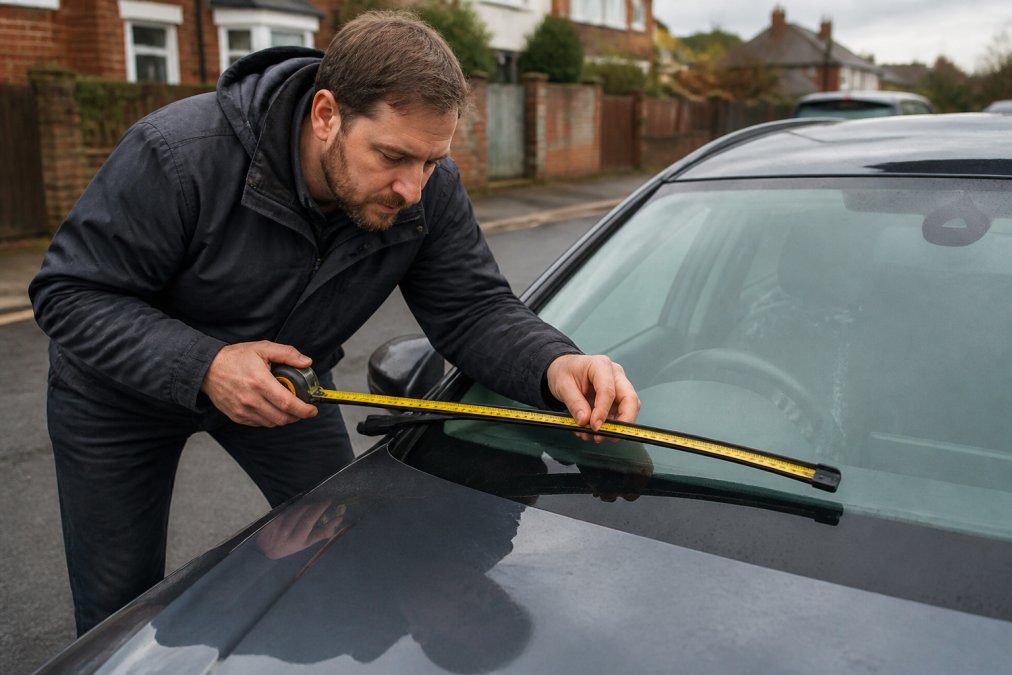
Measuring the blades already on the car works when documentation is missing or the vehicle has been modified. Lift each wiper arm away from the glass, then run a tape measure from the very tip of the rubber to the end of the connector housing.
Record both driver and passenger side separately. They are frequently different lengths, and a set sold as a pair is sized accordingly. Measure in millimetres for the most accurate match against catalogue listings.
Method 3: Check the Owner's Manual or Blade Markings
The owner's manual lists blade lengths in the specifications section, usually alongside bulb types and tyre pressures. If the manual has gone missing, check the blade itself: most manufacturers stamp the length in millimetres on the metal spine or the plastic end cap.
Failing that, a main dealer parts desk will confirm the size from your chassis number. It costs nothing to ask and takes a phone call.
Types of Wiper Blade Connectors Explained
A wiper blade connector is the fitting at the base of the blade that locks it onto the wiper arm, and matching it correctly matters as much as matching the length. Buying the right length with the wrong connector leaves you with a blade that will not attach.
The main types you will encounter:
- Hook arm (J-hook): The most common fitting on older and mid-age vehicles. The arm curves into a J shape and the blade clips over it.
- Pinch tab: A flat arm with a tab that pinches the blade housing. Common on many European models.
- Bayonet: A flat arm with a locating hole, secured by a locking clip. Frequently seen on older German vehicles.
- Push button: A flat arm with a release button on top of the blade connector.
- Slim top / pin: A narrow arm secured by a pin through the blade housing.
A set listed for your specific model should arrive with the correct fitting already sorted, which is why vehicle-specific sets beat universal ones for most drivers.
Signs Your Wiper Blades Need Replacing
Streaking, juddering, and a smeared film left behind after each pass are the clearest signs your wiper blades need replacing. If you are reaching for the washers more often than usual, or the blade skips across the glass rather than gliding, the rubber has hardened.
Watch for these specific symptoms:
- Streaking: Lines of water left behind, usually where the rubber has split or worn unevenly.
- Juddering: The blade chatters across the screen, often a sign the spine has lost tension.
- Squeaking: Rubber has hardened and no longer grips the glass smoothly.
- Missed arcs: Sections of the screen the blade no longer contacts at all.
- Visible damage: Cracks, missing chunks of rubber, or a bent metal spine.
Wiper blades are a consumable, not a lifetime part. Rubber degrades with UV exposure and temperature swings regardless of how often you drive, so a car that sits outside will need blades sooner than one kept in a garage (Historical and Recent Achievements in the Field of Microbial Degradation of Natural and...).
How to Fit New Wiper Blades: A Step-by-Step Guide
Fitting new wiper blades takes around ten minutes for a pair and needs no specialist tools. The process is the same whether you drive a hatchback, saloon, or SUV.
Total Time: 10 minutes Difficulty: Beginner
What You'll Need:
- A new blade set matched to your registration
- A clean cloth
- Glass cleaner
- Park on level ground and switch off the ignition. Leave the wipers in their rest position at the base of the screen.
- Lift the wiper arm away from the glass. On some models you may need to switch the ignition on briefly and stop the wipers mid-screen to get clearance.
- Press the release tab and slide the old blade off. Most connectors release with a firm press and a pull away from the arm.
- Lay the old blade on the cloth. This stops the bare metal arm from scratching the glass if it snaps back.
- Clip the new blade onto the arm until it clicks. Tug it gently to confirm it is seated.
- Lower the arm carefully onto the screen. Never let it drop.
- Repeat on the other side. Remember the two sides are often different lengths.
- Test with the washers. Run a cycle and check for streaks or missed patches.
Expected Result: A silent, streak-free sweep across the full windscreen on both sides.
If you drive a Vauxhall Corsa E, a Vauxhall Corsa E wiper blade set arrives pre-matched to the vehicle with a fitting video, so you skip the sizing step entirely. The same applies to the Ford KA kit for 2008 to 2010 models, which solves the older-vehicle sourcing problem many drivers run into.

Common Mistakes When Checking Wiper Blade Size
The biggest mistake is assuming both blades are the same length. On most cars they are not, and buying two identical blades guarantees one of them will be wrong.
Other errors that trip people up:
- Measuring the arm instead of the blade. The arm length tells you nothing about blade size.
- Rounding to the nearest inch. Catalogue listings work in millimetres, and a 25 mm difference is enough to cause a foul.
- Ignoring the connector type. Length alone does not guarantee a fit.
- Trusting a universal blade for a specific model. Universal blades cover many cars adequately and none of them perfectly.
- Forgetting the rear blade. Many hatchbacks and estates have one, and it is sized separately again.
What most guides miss is that production year matters as much as model name. A facelift mid-cycle can change the arm fitting without changing the badge on the boot.
Getting the sizing right turns a fiddly job into a ten-minute task, and the cost of getting it wrong is a streaky screen and a possible MOT advisory.
Frequently Asked Questions
How do I know what size wiper blades I need?
The quickest way is to enter your vehicle registration into a parts finder, which will show the exact blades for your make, model, and year. Alternatively, measure your existing blades from end to end, or check your owner's manual. Both blades are often different lengths, so check each side separately before ordering.
Can I measure my wiper blades with a tape measure?
Yes. Lift the wiper arm away from the windscreen, measure the blade from the connector to the tip in centimetres, and note the figure. Measure both sides because driver and passenger blades usually differ. Round to the nearest centimetre and match that against the sizes listed for your car.
What happens if I buy the wrong size wiper blades?
A blade that is too long can hit the windscreen pillar or catch the other blade, while one that is too short leaves unwiped areas that reduce visibility in rain. If you order from a retailer with a perfect-fit guarantee and a 30-day returns policy, you can exchange them without losing money.
How often should I replace my wiper blades?
Most manufacturers suggest replacing wiper blades every six to twelve months, or sooner if you notice streaking, juddering, or missed patches. Rubber degrades with sun exposure, frost, and frequent use. If your MOT is due and the blades smear rather than clear, replace them beforehand.