

How to Replace Car Wiper Blades Yourself in Minutes
Last Updated: 2 November 2026
Quick Summary
To learn how to replace car wiper blades, first note the length of each old blade and its fitting type, which is usually a hook, pin or bayonet. Lift the wiper arm away from the glass, press the release tab, slide the old blade off, then click the new one on and lower the arm gently onto the windscreen.
- Measure each blade separately in millimetres, as driver and passenger sides often differ.
- Identify the arm fitting type first: hook, pin, bayonet, or push-button and multi-clip.
- Lift wiper arms slowly, as they are under spring tension and can crack the screen.
- Test new blades on a wet screen, since a dry run tells you little and can scuff the rubber.
- Replace blades once a year, or sooner if they streak, chatter or leave dry patches.
Table of Contents
- Choosing the Right Replacement Wiper Blades
- Identifying Your Wiper Blade Fitting Type
- Preparing Your Car and Lifting the Wiper Arms Safely
- Removing the Old Blade and Fitting the New One
- Testing Your New Blades and Troubleshooting Common Problems
- When to Replace Wiper Blades and How to Keep Them in Good Condition
- Order Your Perfect-Fit Wiper Blades Today
- Frequently Asked Questions
Choosing the Right Replacement Wiper Blades
Learning how to replace car wiper blades is a straightforward job that needs no special tools. Vipa Car Parts sells only wiper blades, so every blade we list is made to fit a specific vehicle. Worn blades streak, smear and chatter, and they can cut visibility when you need it most, such as before an MOT.
Start by checking the blade you already have. Note whether it uses a hook, a pin or a bayonet fitting, and measure its length in millimetres.
Finding the Correct Blade Length for Your Car
Blade length is printed on the old blade or in your handbook. Driver-side and passenger-side blades are often different sizes, so check each one separately. Measure from one end of the rubber to the other.
Keep a note of both lengths before you order. Mixing up the two is the most common reason for buying the wrong set.
Checking Vehicle Compatibility
Enter your registration on our site to see blades matched to your car. Our range covers popular models, including the Mercedes-Benz A-Class W177 Hatchback Aug 2015 Onwards Wiper Blade Kit at £25.99 and the VW GOLF MK7 Hatchback Oct 2012 to Nov 2020 Wiper Blade Set at £27.99.


Our blades are designed to fit UK specification vehicles, which are right-hand drive. Check the make, model and production dates against your registration before you buy.
Identifying Your Wiper Blade Fitting Type
Wiper arms come in several fitting types, and getting this wrong is a common reason a blade that looked right online will not click home. Identify the arm, not the old blade, because the blade carries the matching connector and can be misleading once worn.
Hook (J-hook) arms. The arm tip bends back on itself like a shepherd's crook. The blade slides into the hook and locks when you push it fully home. Hook arms are common on older hatchbacks and saloons. Some hook arms have a small locating notch on the inside of the bend, so check for it before ordering a plain hook blade.
Pin arms. The arm ends in a small horizontal pin, and the blade clips over it with a push-button or side-lock connector. Pin diameters vary, so measure the pin if the listing asks for it. A pin blade fitted to the wrong diameter will feel loose even after it clicks.
Bayonet arms. The arm has a flat tongue that slots into the side of the blade connector, usually secured by a release tab. Bayonet fittings appear on several older European models and some vans.
Push-button and multi-clip arms. Many modern cars use a push-button release on the arm itself, or a multi-clip system where the blade comes with a set of adapters. If your new blade arrives with adapters, match the adapter to the arm shape before fitting, and keep the unused adapters with the packaging in case you change cars.
To confirm the type, lift the arm and photograph the tip from two angles, then compare it with the fitting guide on the product page. If you are still unsure, enter your registration on our site and check the listed fitting type against your photo. vehicle fitting type reference
Watch out: some arms look like hooks but have a closed end cap that stops a standard hook blade sliding on. If the blade will not pass the end of the arm, stop pushing and check for a cap or a different fitting type rather than forcing it.
Preparing Your Car and Lifting the Wiper Arms Safely
Park on level ground and switch the ignition off. Before you start, lift the wiper arms away from the glass so they don't spring back, because knowing how to replace car wiper blades safely starts with this step.
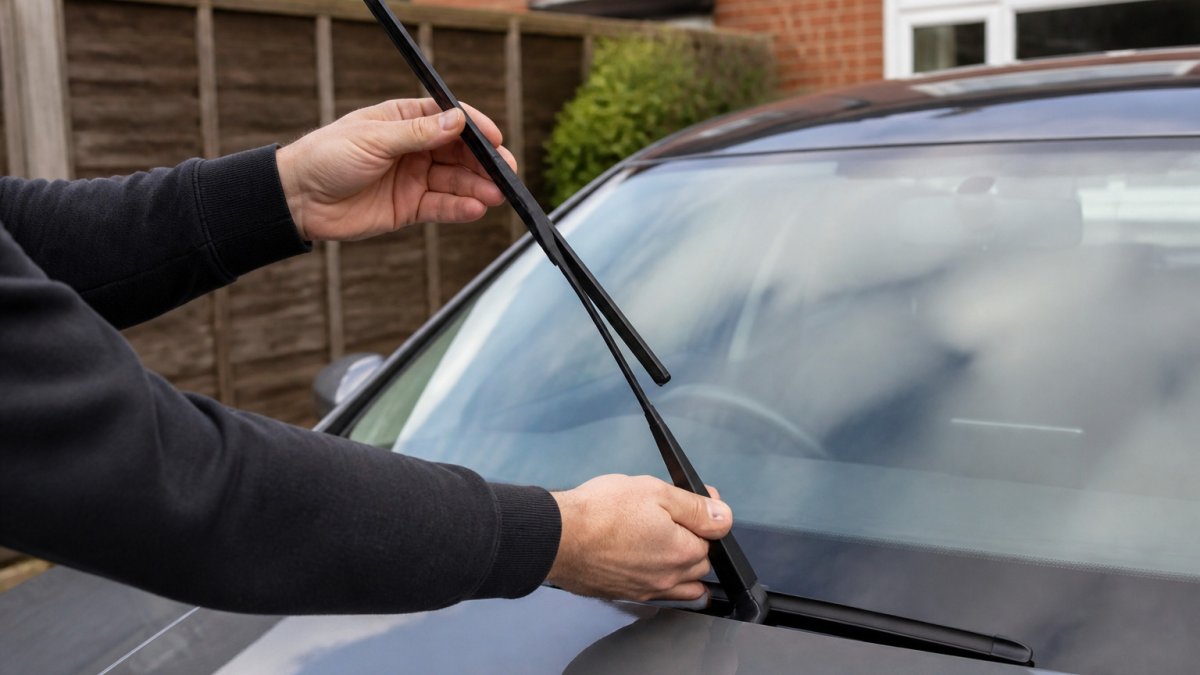
Wiper arms are under spring tension. Lifting them the wrong way can crack the screen or bend the arm.
Handling Spring-Loaded Wiper Arms
Hold the arm near its base, not the blade. Lift it slowly and let it rest in the upright position.
Never let go of an arm that is raised. Lower it gently back onto the glass once you have finished.
VW TRANSPORTER / CARAVELLE MPV Apr 2003 to May 2013 Wiper Blade Set - Easy Fit →
Removing the Old Blade and Fitting the New One
To remove the old blade, press the release tab on the connector and slide the blade off the arm. Hook and pin types usually come away in one movement.
Slide the new blade onto the arm until it clicks into place. Give it a gentle tug to confirm it is secure. Lower the arm slowly onto the windscreen.
Testing Your New Blades and Troubleshooting Common Problems
Run the wipers on a wet screen, not a dry one, for at least a minute on each speed setting. A dry run tells you little and can scuff new rubber. Use screen wash and watch where the blade clears and where it leaves film.
Streaking in bands. A band of missed water usually means the blade is not sitting flat. Check that the connector clicked fully and that the blade is the correct length for that side. If the old blade was the wrong size, the arm may be sitting at the wrong angle.
Juddering or skipping. Judder is often caused by a contaminated screen rather than a faulty blade. Clean the glass with a proper glass cleaner and a microfibre cloth, then clean the blade edge with a damp cloth. If judder persists, check that the arm is not bent and that the blade is seated squarely in the connector.
Squeaking or chattering. Noise can come from a dry screen, a twisted arm or a blade that is too long and catching the edge of the glass. Compare the new blade length with the old one before assuming the blade is at fault.
Poor contact in the middle or at the ends. Press gently along the blade to feel for gaps. A gap at one end can mean the arm spring is tired, which is an arm replacement issue rather than a blade issue. A gap in the middle can mean the blade has been stored bent or the connector is not fully home.
Loose fitting. Give the blade a firm tug along the arm axis after fitting. If it moves, the release tab has not engaged. Remove it, check for an adapter left on the arm from the old blade, and refit.
Rear blade differences. Rear wipers often use a smaller blade and a different arm fitting, and some rear arms are hidden under a spoiler or need the tailgate glass opened for access. Test the rear blade separately, because a rear blade that misses the glass is usually a fitting or arm-angle problem rather than a worn rubber.
If a new blade still streaks after cleaning and refitting, compare it with the old blade for length and curvature, and check the vehicle handbook for the specified sizes. A persistent fault after refitting often points to the arm or the screen rather than the blade.
The table below sums up the most common faults and what usually causes them.
| Problem | Cause | Fix |
|---|---|---|
| Streaking in bands | Blade not sitting flat or wrong length | Check connector clicked fully and length matches that side |
| Juddering or skipping | Contaminated screen | Clean glass and blade edge with a damp cloth |
| Squeaking or chattering | Dry screen, twisted arm or blade too long | Compare new blade length with the old one |
| Gaps at the ends | Tired arm spring | Treat as an arm replacement issue |
| Gap in the middle | Blade stored bent or connector not fully home | Check the connector is fully home |
| Loose fitting | Release tab not engaged | Remove, check for an old adapter, and refit |
When to Replace Wiper Blades and How to Keep Them in Good Condition
Replace blades once a year, or sooner if they streak, chatter or leave dry patches. Clean them every few weeks with a cloth and screen wash to remove road dirt.
Park away from direct sun where possible, as heat and UV dry out the rubber.
Order Your Perfect-Fit Wiper Blades Today
Our fitting guides and vehicle search make it simple to find the right blades. We offer free delivery on all orders and 30-day no-quibble returns, so you can order with confidence.
Find wiper blades at Vipa Car Parts and get back on the road with clear, streak-free vision.
Frequently Asked Questions
How do you replace car wiper blades?
Lift the wiper arm away from the windscreen, press the release tab or slide the blade off its hook fitting, then fit the new blade until it clicks into place. Lower the arm gently back onto the glass. Always check the new blade sits firmly before driving, and keep the arm supported while working so it cannot spring back onto the glass.
How do I know which wiper blades fit my car?
Enter your vehicle registration on the Vipa Car Parts site to see the correct sizes and fitting type for your car. Check the make, model, body style and production dates against your vehicle log book. If you are unsure, measure your existing blades in millimetres and compare them with the listed sizes before ordering. Vipa offers a perfect-fit guarantee and 30-day no quibble returns if something is not right.
Are front and rear wiper blades the same size?
No. Front and rear wiper blades are usually different lengths and often use different fittings, so they cannot be swapped. Many cars have a driver's side blade, a passenger side blade and a separate rear blade. The VW Golf Mk7 Hatchback set, for example, uses different sized front blades alongside a different sized rear blade, which is why buying a matched set for your exact model avoids mistakes.
When should I replace my wiper blades?
Replace wiper blades when they streak, smear, skip or leave dry patches on the glass, or when the rubber is cracked, split or hardened. Blades that have been left in strong sunlight for long periods tend to wear out faster. Many UK drivers replace them once a year, and it is sensible to check them before an MOT inspection so you can see clearly in all weather conditions.
