

How to Stop Wiper Blades Freezing to Your Windscreen
Quick Summary
Wiper blades freezing to the windscreen happens when moisture from rain, sleet or melted snow turns to ice overnight, bonding the rubber to the glass. To stop it, lift the wiper arms into the service position or cover the windscreen while parked, and never force a frozen blade free.
- Lift the wiper arms into the service position overnight, but skip this in heavy snow or strong wind.
- A full windscreen cover fits more securely than a loose sheet, which can blow away or scratch paint.
- Thaw frozen blades with a warm heater and demister, then add de-icer along the blade edge only.
- Never pour hot or boiling water on the windscreen or blades, as sudden temperature change can crack glass.
- Replace blades that streak, squeak or skip, as they usually last about six to twelve months.
Table of Contents
- Why Wiper Blades Freeze to the Windscreen
- Preventing Blades From Sticking Overnight
- How to Unfreeze Windscreen Wipers Safely in the Morning
- How to Defrost a Car Windscreen Safely
- Should You Lift Wiper Blades in Winter?
- Product Safety: De-icer, Screenwash and Material Compatibility
- Checking Your Blades Before Switching On and When to Replace Them
- Frequently Asked Questions
Why Wiper Blades Freeze to the Windscreen
Wiper blades freezing to the windscreen happens when moisture from rain, sleet, or melted snow turns to ice while the car is parked. The rubber edge bonds to the glass, and the blade can tear, split, or strain the wiper motor when you switch on the wipers.
There are two separate causes, and each needs a different fix.
Overnight freezing versus ice build-up while driving
Overnight freezing happens while the car is parked. Water settles on the glass and the rubber blade, then freezes as the temperature drops below zero.
Ice build-up while driving is different. It forms as you drive through sleet, freezing spray, or wet snow.
Watch out: Never force a frozen wiper free by pulling hard on the arm. This can snap the arm, tear the blade, or damage the wiper motor.
Preventing Blades From Sticking Overnight
The simplest way to stop wiper blades freezing is to keep them off the glass overnight. Two methods work well, and many drivers use both.
Lifting the wipers into the service position
Lifting the wiper arms into the service position keeps the blades away from the windscreen.
- Turn the ignition on, then switch the wipers on briefly.
- Switch the wipers off so they stop at the bottom of the screen.
- Turn the ignition off, then lift each arm gently away from the glass.
Do not raise the arms in heavy snow or when the blades are already frozen to the glass. Lifting a frozen arm can strain it.
Using a windscreen cover or covering the blades
A windscreen cover keeps frost and snow off the glass and blades. A car-specific cover fits more securely than a loose sheet, which can blow away or scratch the paint.
Covering just the blades is a cheaper option. A tight-fitting blade cover or an old towel can stop ice forming on the rubber.
Watch out: Do not leave a wet towel on the blades overnight. It can freeze to the rubber in the same way.
How to Unfreeze Windscreen Wipers Safely in the Morning
If the blades are already frozen, the goal is to free the rubber from the glass without tearing it, straining the wiper linkage or cracking the windscreen. Work slowly and check progress at each stage rather than switching the wipers on and hoping for the best.
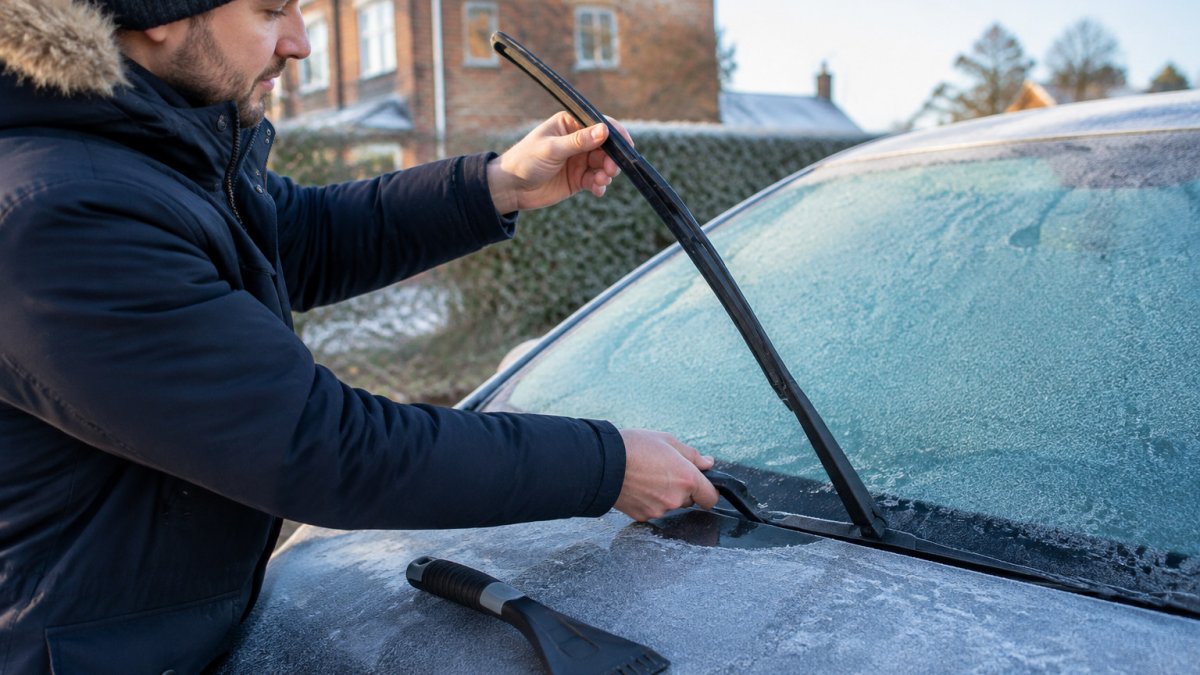
Before you start the car
- Look at the blade edge where it meets the glass. If you can see a continuous line of ice along the rubber, the blade is bonded and must be freed before the wipers move.
- Clear loose snow from around the base of the windscreen and from the scuttle panel, so meltwater has somewhere to drain.
- Check that the wiper arms are not already in the raised service position. If they are, lower them gently onto the glass before you start the heater, so the warm air can reach the blade.
- Do not tug the arm to test whether the blade is free. A bonded blade can tear along the rubber spine, and a seized linkage can bend the arm.
Thawing the blade and glass together
- Start the engine and set the heater to warm, with the front demister on and the fan at a moderate speed. Direct the vents towards the windscreen.
- Wait several minutes. The glass warms from the inside out, and the ice at the blade edge begins to loosen before the surface looks clear.
- Spray a small amount of winter screenwash or a de-icer labelled as safe for rubber and paint along the blade edge, not across the whole screen. Give it a minute to work.
- Gently lift each wiper arm a few centimetres and lower it again. If it moves freely, the blade is loose. If it resists, stop and wait longer.
- Only switch the wipers on once every blade moves freely. Run them for a few sweeps, then switch off and check the rubber for splits or missing sections.
Watch out: Never pour hot or boiling water on the windscreen or the blades. The sudden temperature change can crack the glass, and hot water can distort the rubber and strip wax from the paint.
If the blade will not free
A blade that stays stuck after ten to fifteen minutes of gentle heat is usually bonded by a thick ridge of ice rather than a thin film. In that case, apply more de-icer to the blade edge, wait, and try again. Do not use an ice scraper on the rubber, because the scraper edge will cut into the blade. Use the scraper on the glass only, and keep it flat to the surface.
Checking before you drive
Once the blades are free, switch the wipers on for a single sweep and watch the pattern. A blade that skips, chatters or leaves a wet patch is either still partly frozen or worn. Clear the rest of the windscreen with the demister and scraper before pulling away, and check that the washer jets are delivering fluid rather than a weak dribble.
How to Defrost a Car Windscreen Safely
Defrosting the whole windscreen takes time, but it is the safest way to clear ice. Many drivers rush this step, and that is when glass gets damaged.
- Use the car's heater and demister at a warm setting.
- Start with the windscreen fan and the rear demister.
- Scrape away loose ice with a plastic ice scraper.
Should You Lift Wiper Blades in Winter?
Lifting the wiper arms overnight is one of the most repeated tips for this problem, and it is also one of the most argued about. The honest answer is that it depends on the car, the weather and where it is parked. Compare winter and summer blades to see whether winter-specific blades suit freezing conditions better. Lifting works well in some conditions and creates new risks in others.
When lifting helps
Raising the arms keeps the rubber off the glass, so any moisture that freezes overnight forms on the arm and blade rather than bonding the two together. It is most useful when:
- heavy frost or freezing fog is forecast;
- the car will sit outside for several days;
- snow is expected to fall and then melt and refreeze;
In these conditions, a lifted arm is usually quicker to clear in the morning than a bonded blade, and it removes the temptation to force the wipers free.
When not to lift the arms
Lifting is not risk-free, and several situations call for leaving the arms down:
- Strong wind. A raised arm acts as a sail. Gusts can push it back against the glass hard enough to crack the windscreen or bend the arm.
- Steep slopes or exposed parking. The same wind risk applies, and a raised arm can catch on a wall, hedge or another vehicle.
- Cars with a hidden or recessed wiper park position. Many modern models tuck the arms below the bonnet line. Forcing them up from the parked position can damage the linkage or the trim. Use the service position instead.
Using the service position correctly
Most cars with a recessed park position have a service or maintenance mode that moves the arms to a raised point on the screen. The procedure varies by model, so check the vehicle handbook.
Watch out: Do not leave the car in service mode with the arms raised in an automatic car wash or in high winds, and remember to return the arms to the park position before driving.
A practical comparison
There is no single best method. The table below sets out how the main options compare on effectiveness, convenience and limitations, so you can choose based on your car and the forecast.
| Method | Effectiveness | Convenience | Limitations |
|---|---|---|---|
| Lift arms (or use service position) | High in frost and snow | Quick once you know the procedure | Wind risk, linkage strain on some models, not suitable for all park positions |
| Full windscreen cover | High, protects glass and blades | Fitting and removal in the dark | Needs a car-specific fit; loose covers can scratch paint |
| Blade covers only | Moderate | Cheap and quick | Can trap moisture and freeze to the rubber if wet |
| Winter screenwash only | Low as a prevention, high as a thaw aid | No extra steps | Does not stop overnight bonding on its own |
For most drivers, the best routine is a combination: winter screenwash in the washer bottle, a windscreen cover or blade covers overnight, and the service position used only when the handbook says it is safe and the weather is calm.
Winter screenwash and blade costs at a glance
Product Safety: De-icer, Screenwash and Material Compatibility
Choosing the right fluid protects both the glass and the rubber. Look for products made for car windscreens, and read the label before you use them.
- Screenwash with antifreeze protection is designed for winter driving. Check the temperature rating on the bottle.
- De-icer sprays melt ice on glass. Choose a product that is safe on rubber and paint.
- Avoid household chemicals such as strong cleaners, which can dry out or damage wiper rubber.
A worn or split blade does not grip well and is more likely to freeze or streak. If the rubber is cracked or stiff, replacing the blades is the best fix.
Checking Your Blades Before Switching On and When to Replace Them
Check the blades before you switch on the wipers, especially after a frosty night. If they need replacing, fitting new blades yourself is quicker than you might expect.
Replace the blades when you notice streaking, squeaking, skipping, or patches of glass that stay wet. Check the signs that your blades need replacing if you are unsure whether they are worn enough to stick.
If you are unsure which blades fit your car, check the make, model, and year first. Confirm blade compatibility for your specific car before you buy. Vipa Car Parts supplies matched wiper blade sets for specific vehicles, including the Vauxhall Corsa E Hatchback Oct 2014 to Nov 2019 Front & Rear Wiper Blade Set at £27.99, the BMW 3 Series F30 Saloon Oct 2009 onwards Front Wiper Blade Kit at £25.99, the Mercedes-Benz A Class W177 Hatchback Apr 2018 Onwards Wiper Blade Set at £29.99, and the Jaguar F-Pace SUV Sep 2015 onwards Front & Rear Wiper Blade Set at £27.99.

Frequently Asked Questions
How do I stop my wiper blades freezing to the windscreen?
Lift the wiper arms away from the glass when parking overnight, so the blades are not pressed against the frozen surface. Where you cannot lift them, place a windscreen cover over the glass or lay a towel over the wipers. Keeping the blades clean and checking they are not split or perished also reduces the chance of them bonding to the glass. Avoid parking with wet blades on a freezing night, as moisture is what sets them in place.
What should I do if my wipers are frozen to the windscreen?
Do not switch the wipers on, as this can tear the rubber or strain the wiper motor. Start the engine and run the heater on a low-to-medium setting with the fan directed at the windscreen. Use a plastic ice scraper or a de-icer spray, and gently ease each blade free from the glass by hand. Once the blades move freely, clear the remaining ice before driving so your view is fully clear.
Can I pour warm water on a frozen windscreen?
It is not advisable. Pouring warm water onto a cold windscreen can cause the glass to crack from sudden temperature change, and the water can refreeze on the surface, making the problem worse. A safer approach is to use a proper de-icer or screenwash designed for winter, or to let the car warm up gradually with the heater running. Always avoid boiling water under any circumstances.
Can de-icer damage wiper blades?
Some products can affect rubber over time, particularly those with high alcohol or harsh chemical content. Use a de-icer or winter screenwash made for vehicle glass, apply it sparingly, and wipe away any excess. Avoid spraying directly onto the rubber element for long periods. Check that any product you buy is suitable for both glass and rubber, and follow the manufacturer's instructions.
